Guide to Job Opportunities and Success Points for Mongolian Employees in Japan
Guide to Job Opportunities and Success Points for Mongolian Employees in Japan
Mongolians
正社員
2026.08.03
Employment Situation and Full-Time Job Opportunities for Mongolians in Japan
The employment situation for Mongolians in Japan has clearly changed in recent years. In particular, the number of job openings for full-time employees has been on the rise, and there are several reasons for this. First, the labor shortage in Japan's job market has become serious, leading to a demand for foreign workers. Specifically, the diligence and adaptability of Mongolians are being recognized, prompting companies to actively recruit them. Against this backdrop, the number of full-time job opportunities for Mongolians in Japan is also increasing.
Furthermore, as globalization progresses, there is a growing need for talent with an international perspective, making the recruitment of Mongolians even more important. In particular, in specific fields such as IT, construction, and manufacturing, advanced skills and communication abilities are required, leading to an increasing demand for Mongolians in these areas. Thus, the growing opportunities for Mongolians to work as full-time employees in Japan reflect the changing employment market in line with the times.
By reading this article, readers can learn specific methods for Mongolians to find employment in Japan. It provides tips for job searching, information on necessary visas, and how-tos for achieving success. This will help Mongolians realize the value of full-time job opportunities and connect them to actual applications. Given the current situation where many job openings are available, utilizing the right information greatly increases the chances for Mongolians to succeed in the Japanese labor market. The future of Mongolians in Japan's job market is bright, and the expansion of full-time job opportunities plays a part in that.
Checkpoint
In Japan, the employment situation for Mongolians is improving, with an increase in full-time job openings. Amidst labor shortages and globalization, the demand for Mongolians is particularly rising in sectors such as IT and manufacturing. Opportunities for Mongolians to work as full-time employees in Japan are increasing, making job searching and visa acquisition methods important. The future for Mongolians in the Japanese job market is bright.
Background for Mongolians Seeking Employment in Japan
Wage Disparity: Compared to Mongolia, Japan's wages are higher, prompting Mongolians seeking a better life to aim for employment as full-time workers.
Career Development: Mongolians aspire to secure a full-time position, believing that their experiences in Japan will lead to future career advancement.
Japanese Language Learning: There is a strong desire to acquire Japanese language skills and enhance abilities to achieve employment in Japanese companies while in Japan.
Family Factors: The aspiration to succeed in Japan is closely tied to the support and expectations of their families in Mongolia.
Expansion of Acceptance: As Japanese companies seek overseas talent, it has become easier for Mongolians to target full-time job openings.
International Students: Mongolians who studied in Japan have many employment opportunities and are increasingly favored.
Job Change Needs of Technical Interns and Specified Skilled Workers: Due to their practical experience in Japan, Mongolians possess high employment competitiveness.
For those studying in Japan as international students, it is important to strengthen your Japanese language skills and keep an eye on your ideal employment destination. For those residing in the country, it is recommended to expand your network and actively search for job information. For Mongolians living abroad, gathering information online and understanding Japanese culture is crucial. Understanding these factors will help Mongolians achieve employment as regular employees in Japan.
Key Points
The background for Mongolians aiming for employment as regular employees in Japan includes personal factors such as wage differences, career development, Japanese language learning, and family expectations. Additionally, the expansion of acceptance, preferential treatment for international students, and the job change needs of technical interns also have an impact. It is important to proceed with an approach tailored to your own situation.
Trends in Employment of Mongolians in the Japanese Labor Market
The trends in employment of Mongolians in the Japanese labor market have shown significant changes in recent years. Let's take a look at the changes in the number of Mongolians residing in Japan. According to statistics from the Immigration Services Agency, the number of Mongolians residing in Japan reached approximately 15,000 by the end of 2025. This indicates an increase of about 10% from the previous year, showing that the migration of Mongolians to Japan is accelerating.
Analyzing the composition by residence status, there is a growing trend of Mongolians holding residence statuses such as Technical, Humanistic Knowledge, and International Services (Toki) and Specified Skilled Worker. In particular, the number of Mongolians with Specified Skilled Worker status increased by about 15% from the previous year in 2025, accounting for 30% of the total. This indicates that Japanese companies are actively hiring Mongolians with specified skills.
The trends in occupations with high job openings include manufacturing and IT-related positions. According to data from the Ministry of Health, Labour and Welfare, about 40% of job openings for Mongolian regular employees in 2025 are related to manufacturing, while IT-related positions account for about 25%. These occupations are in high demand as they can utilize the skills and experience of Mongolians.
From these statistical data, it can be seen that the employment situation of Mongolians in the Japanese labor market shows trends such as an increase in the number of residents, an increase in those obtaining specified skill qualifications, and an increase in job openings in manufacturing and IT-related fields. These trends indicate an expansion of employment opportunities for Mongolians in Japan and are points to watch in the future.
Employment of Mongolians in Japan is a trend to watch in the future, due to the increase in the number of residents and specific skill qualifications, as well as the expansion of job openings in manufacturing and IT sectors.
Key Points for Mongolians to Work as Full-Time Employees
For Mongolians to successfully find employment as full-time employees in Japan, it is essential to first understand the evaluation criteria that employers look for. The particularly important aspects are Japanese language proficiency, work experience, suitability of residency status, cultural adaptability, and quality of application documents. By thoroughly checking these points and taking measures, Mongolians can get closer to successfully finding employment in Japan.
First, let's touch on Japanese language proficiency. What companies seek is not only the ability to engage in daily conversation but also the language skills necessary for performing tasks. In particular, the ability to handle business terms and specialized vocabulary is required, as it is key to improving work efficiency. Therefore, it is important not to neglect regular Japanese language study.
Next, work experience is a direct indicator of your strengths. It is necessary to clearly showcase how your past experiences can be beneficial in your application documents and interviews. Experience in related fields can be a powerful asset, so it is advisable to organize your experiences, including both failures and successes.
Additionally, suitability of residency status is extremely important. Companies prioritize whether there are any legal issues, so it is essential to confirm that you have the appropriate residency status. It is advisable to consult with experts as needed to obtain accurate information.
Furthermore, cultural adaptation is also an essential factor. By flexibly adapting to the workplace culture and communication style in Japan, it becomes possible to build trust within the workplace. This requires an effort to understand Japan's unique manners and customs.
Lastly, let's talk about the quality of application documents. Resumes and work history documents play a crucial role in determining the first impression. It is important to ensure that the content is clear and free of typos, and to effectively convey your appeal through your motivation for applying and self-promotion. Keep these elements in mind and apply them to each application.
Utilizing these five perspectives, the next section will explain each element in more detail and introduce specific strategies for Mongolians to successfully secure full-time employment in Japan.
Note
For Mongolians working as full-time employees in Japan, Japanese language skills and cultural adaptation are particularly important. Also, please pay close attention to the confirmation of residency status and the quality of application documents. Furthermore, organizing your work experience properly and appealing to companies appropriately will be the key to success.
The Impact of Japanese Language Proficiency on Employment
Japanese language proficiency is a crucial factor for Mongolians seeking employment as full-time employees in Japan. In particular, the level of the Japanese Language Proficiency Test (JLPT) significantly affects the range of jobs available, interview evaluations, and the ability to adapt after joining a company. For example, if one has obtained N1, companies expect a high level of Japanese proficiency, allowing for applications to more specialized positions. On the other hand, at the N3 level, job opportunities are often limited to general office work or manufacturing roles. Below is a table summarizing the required Japanese language proficiency by job type.
Job Type
Required JLPT Level
IT Engineer
N2 or higher
Sales position
N1 or N2
Administrative position
N3 or higher
Manufacturing industry
N3 or higher
Caregiving profession
N2 or higher
For Mongolians with limited Japanese skills, alternative options are available. For example, you can prove your abilities by applying for jobs that use English or by submitting a technical portfolio. Additionally, creating a study plan to learn Japanese after joining the company can facilitate smooth communication in the workplace. By taking appropriate measures like these, it is possible to secure a full-time job in Japan. It is important for Mongolians to utilize such methods to increase the number of job opportunities in Japan.
Attention
When aiming for employment in Japan, not only Japanese language proficiency but also the required skills and experience for each job type are important. Moreover, since job information varies by company, it is necessary to carefully check the conditions. Furthermore, it is essential to leverage alternative options and highlight your strengths.
When Mongolians apply for regular employee positions in Japan, it is important to check the following items. I have organized them into four main categories: application documents, interviews, suitability and practical skills, and residency qualifications.
First, regarding application documents. Resumes and work history documents are crucial elements that determine the applicant's first impression. In particular, the work history document should concisely outline past experiences and demonstrate how work experience in Mongolia can contribute to Japanese companies. Additionally, the statement of purpose should be clearly articulated, avoiding vague expressions.
Next, the preparation for the interview. In Japanese corporate culture, self-promotion and enthusiasm for the job during the interview are highly valued. Even if Japanese language skills are lacking, it is important to show a proactive attitude and provide simple and clear answers to the interviewer’s questions. Also, remember to prepare appropriate attire and politeness during the interview, as making a good impression is essential.
In terms of suitability and practical skills, it is important to research what skills are required for the position you are applying for in advance. Specifically, preparing according to the abilities that companies seek and being able to cite specific instances where past experiences can be utilized will be beneficial.
Finally, let's confirm your residency status. If your residency status does not match the job type you are applying for, it will be difficult to apply. As a Mongolian, it is essential to obtain the correct residency status to work as a full-time employee in Japan and to ensure that this status is reflected in your application documents. Timing is also crucial for salary negotiations, as it can lead to consensus. It is important to note that you should avoid salary negotiations at the initial stage if there is a mismatch in residency status.
In this way, when Mongolians apply for full-time job openings in Japan, it is necessary to firmly grasp each of the points mentioned above. Below are the steps that organize this process.
Prepare your application documents (resume and work history) appropriately.
Prepare for the interview and prepare your self-promotion.
Check the skills required for the job and highlight your practical experience.
Double-check that the residency status matches the application details.
Time the salary negotiation appropriately.
By following these steps, the chances of success when applying for full-time jobs in Japan will increase. It is essential for Mongolians to reflect on these points and strive for better results.
Key Points to Consider When Applying for Jobs
When Mongolians apply for full-time jobs in Japan, it is important to prepare application documents, conduct interview preparation, confirm suitability and practical experience, and ensure the residency status matches. Additionally, pay attention to clarifying your motivation for applying and the timing of salary negotiations.
There are several job search channels for finding full-time job openings for Mongolians. By utilizing these, you can efficiently advance your job search activities in Japan. Below are the most effective options.
First, job sites are a powerful source of information. In particular, sites like "Rikunabi NEXT" and "Mynavi Career Change" cover a wide range of full-time job openings. If you are residing in Japan, it is important to make good use of these sites and apply for your desired positions. On the other hand, international job sites like "LinkedIn" and "Indeed" are suitable for Mongolians living abroad. Also, consider applying directly through the official websites of companies.
Next, utilizing agents is also very effective. Specialized agents have networks with companies and are aware of market trends. Therefore, by choosing agents that specialize in Mongolians, you increase the chances of finding full-time job openings that match your needs. If you are living in Japan, you can have face-to-face meetings, which allows you to receive professional advice, giving you an advantage.
Furthermore, Hello Work is an important resource for obtaining local job information. It is available not only to residents but also to Mongolians visiting Japan, and job consultation services are also offered. By using this government-provided service, you can confidently explore job opportunities.
The university career center is also a point that cannot be ignored. Special programs and internship information are abundantly provided for students and graduates. In particular, international students from Mongolia can gain advantageous information. Participating in career events and seminars on campus can also serve as an opportunity for new encounters.
In addition, it is worth utilizing referrals from acquaintances and social media. Especially by using platforms like Facebook and Twitter, you can obtain information directly from Mongolians working in Japanese companies. Recommendations from followers and friends can also provide opportunities to interview for positions as a full-time employee.
Finally, the use of social media can be mentioned. By valuing interactions on platforms like LinkedIn and Facebook and regularly checking company pages and job information, information gathering becomes smoother. In particular, by joining groups focused on Japanese companies, you will be able to access more specific job information.
By combining these channels, the chances of Mongolians obtaining job offers as full-time employees in Japan will increase more efficiently and effectively. Especially since the approaches differ between those residing in Japan and those living abroad, discerning information suited to each situation will be the key to success.
Notice
When Mongolians are looking for full-time job opportunities in Japan, it is important to understand the characteristics of each information source and how to use them appropriately. In particular, since the approach differs between those living in Japan and those living abroad, please make sure to choose the method that is best suited to your situation. Additionally, it is essential to work on the quality of your application documents and to improve your Japanese language skills.
Comprehensive job site is a convenient tool for Mongolians hoping to find employment in Japan, allowing them to search for various industries and job types of full-time job information all at once. For example, Rikunabi NEXT and Mynavi Career Change can be mentioned. These sites provide a wide range of job information, making it easier for Mongolians to find suitable full-timejob listings. However, there may be limited special support for Mongolians, and they may find it difficult to gather information in Japanese. Additionally, information regarding residency status confirmation and fees can sometimes be unclear, so caution is necessary.
Job sites for foreigners
Job sites for foreigners are designed to support foreigners, including Mongolians, in finding employment in Japan. Examples include GaijinPot Jobs and Daijob.com. These sites make it easier for Mongolians to find full-timejob listings in Japan, and also provide information regarding residency status confirmation and fees. However, the number of job listings may be limited, and it may be difficult to find full-timejob listings in the desired industries or job types.
Industry-specific job sites
Industry-specific job sites provide job information specialized in specific industries or job types. For example, Find Job! specializes in the IT industry, and Monozukuri Job Navi specializes in the manufacturing industry. These sites make it easier for Mongolians to find full-timejob listings in their desired industries or job types. However, since they are limited to specific industries or job types, there may be cases where the desired full-timejob listings cannot be found.
Agent Services
Agent Services is a specialized service that supports Mongolians in finding employment in Japan. For example, there are services like JAC Recruitment and Robert Walters Japan. These services introduce Mongolianfull-timejob offers and also provide support for residency status verification and fees. However, there may be fees associated with using the service, and the conditions regarding MongolianJapanese language proficiency and residency status can be strict.
Public Support Organizations
Public Support Organizations are government and local agency bodies that assist Mongolians in finding employment in Japan. For example, there are organizations like Hello Work and JETRO. These organizations provide information on full-timejob offers for Mongolians and also offer support for residency status verification and fees. However, there may be limited special support available for Mongolians, and it can be challenging to gather information in Japanese.
Here are the points
When Mongolians seek employment in Japan, there are various job media available, including comprehensive job sites, job sites for foreigners, industry-specific job sites, agent services, and public support organizations. Please understand the characteristics, strengths, and weaknesses of each and use this as a reference to find job openings for full-time positions that suit you.
Job Trends for Full-Time Positions in the IT Industry
The IT industry is an attractive field for Mongolians in the Japanesejob market. Due to technological innovation and the advancement of digitalization, the number of full-time job openings in the IT industry is on the rise. In particular, there are many job openings that accept no experience, and the Japanese language requirements may be set relatively low, often at N3 or above on the Japanese Language Proficiency Test. Possible career paths include promotion from system engineer to project manager, and eventually to CTO (Chief Technology Officer). For example, ||Technology A Co., Ltd.|| is actively hiring Mongolianfull-time employees and offers job openings that accept no experience. *This information is fictional and does not represent a real company.
Trends in Full-Time Job Openings in the Manufacturing Industry
The manufacturing industry is a field with many stable full-time job openings for Mongolians in the Japanesejob market. Full-time job openings in the manufacturing industry tend to favor experienced candidates, particularly those with experience in machine operation and quality control. Japanese language requirements typically require a Japanese Language Proficiency Test (JLPT) level of N2 or higher. Possible career paths include promotions from line leader to production management, and eventually to factory manager. For example, ||Monozukuri B Co., Ltd.|| is hiring Mongolians for full-time positions and offers job openings that favor experienced candidates.
Trends in Full-Time Job Openings in the Food Service Industry
The food service industry is a field with a variety of full-time job openings for Mongolians in the Japanesejob market. Job openings in the food service industry often accept no experience, and the Japanese language requirements typically require a Japanese Language Proficiency Test (JLPT) level of N3 or higher. Possible career paths include promotions from hall staff to store manager, and eventually to area manager. For example, ||Dining C Co., Ltd.|| is hiring Mongolians for full-time positions and offers job openings that accept no experience.
Trends in Full-Time Job Openings in the Hospitality Industry
The hospitality industry offers many opportunities for Japaneseemployment in an international environment for Mongolians. The hospitality industry has a high number of full-time job openings that are open to inexperienced candidates, and the Japanese language requirement is typically N3 or higher on the Japanese Language Proficiency Test. Possible career paths include promotion from front staff to front manager, and then to hotel manager. For example, ||Hotel Green D Co., Ltd.|| is hiring Mongolians for full-time positions and offers jobs that are open to inexperienced candidates.
Trends in full-time job openings in the logistics industry
The logistics industry is a field with many stable full-time job openings for Mongolians in the Japaneseemployment market. The logistics industry has many full-time job openings that are open to inexperienced candidates, and the Japanese language requirement is typically N3 or higher on the Japanese Language Proficiency Test. Possible career paths include promotion from driver to delivery management, and then to logistics center manager. For example, ||Logistics E Co., Ltd.|| is hiring Mongolians for full-time positions and offers jobs that are open to inexperienced candidates.
Trends in full-time job openings in the construction industry
The construction industry is a field with many full-time job openings that favor Mongolians in the Japaneseemployment market. The construction industry has many full-time job openings that favor experienced candidates, particularly those with experience in construction management or site supervision. Possible career paths include promotion from site supervisor to construction management, and then to project manager. For example, ||Construction Tech F Co., Ltd.|| is hiring Mongolians for full-time positions and offers jobs that favor experienced candidates.
Job Market Trends Summary
IT, manufacturing, food service, accommodation, logistics, and construction industries are actively offering full-time job openings for Mongolian individuals. Many positions are available for those with no experience as well as those with experience, and there are plenty of potential career paths. Japanese language requirements vary by industry, but there are job opportunities available.
Industry
Job Features
IT Industry
No experience required, abundant career paths
Manufacturing industry
Experienced candidates preferred, stability
Food service industry
No experience required, international environment
Accommodation Industry
No experience required, customer service skills improvement
Visa and legal requirements for employment in Japan
For Mongolians seeking to work as full-time employees in Japan, it is essential to accurately understand the residency status and legal requirements. The most important point is that to work as a full-time employee, you need to have a specific residency status. Simply being employed as a full-time employee does not mean that all visas are applicable. In fact, the required residency status varies depending on the job type, company size, and industry.
For example, there are many visas that require specific skills or qualifications, such as "Technical, Humanities, and International Services" or "Management and Administration." If Mongolians wish to seek employment in Japan, it is important to thoroughly understand the types and requirements of such visas. A common misconception is that "any visa allows you to work as a full-time employee," but in reality, it is difficult to work legally in Japan without the appropriate residency status.
In addition, the companies that offer employment must also meet certain requirements regarding residency status. For example, whether they meet the conditions for hiring individuals with appropriate skills significantly affects the company's eligibility. Therefore, it is essential for Mongolians considering employment in Japan to accurately understand the laws and visa information.
Ultimately, it is strongly recommended to confirm details about visa applications and residency status with professionals such as a gyoseishoshi (administrative scrivener) or the immigration bureau. By receiving appropriate advice, you can obtain accurate information tailored to your situation.
For Mongolians to work as full-time employees in Japan, obtaining specific residency status and understanding legal requirements are essential. It is important to verify accurate information with professionals.
Summary of Key Points
For Mongolians to secure employment as full-time employees in Japan, it is important to understand the specific residency status requirements and legal conditions. To avoid misunderstandings, it is recommended to confirm accurate information with specialized administrative scriveners or the immigration bureau.
Target Occupations:Engineers, Designers, Translators, Interpreters, etc. in Japanese companies.
Educational Background and Work Requirements:Japan requires graduation from a relevant field at a university in Japan, or equivalent education and work experience.
Ease of Job Change:Job changes within Japan are possible, but employer consent is required.
Family Accompaniment:Accompaniment of family members to Japan is permitted.
Points to Note:Due to fluctuations in the Japanese labor market, it may become difficult to renew employment contracts.
Specified Skills
Target Occupations:Japan in the fields of manufacturing, construction, agriculture, nursing care, and more.
Educational and Practical Requirements:A degree in a related field from a vocational school or university in Japan, or passing a specific skills examination is required.
Family Accompaniment:Family accompaniment to Japan is generally not permitted.
Skills
Target Occupations:Japan in the fields of manufacturing, construction, agriculture, fishing, and more.
Management and Administration
Target Occupations:Executives and managerial positions in companies in Japan.
Procedures for Changing from Study Abroad to Employment
If international students in Japan wish to engage in job hunting, it is necessary to change their residency status. If you graduate from a university or vocational school in Japan, it is possible to change to a Japanese work visa by receiving a job offer from a Japanese company. However, since the procedures may take time, early preparation is recommended.
Summary of Key Points
In order for Mongolians to work as full-time employees in Japan, various work visas are required. Typical visas include "Technical, Humanities, and International Services," "Specified Skills," "Skills," and "Management and Administration." Additionally, when switching from student status to employment, a change of residency status procedure is necessary.
When Mongolians seek to work as full-time employees in Japan, the application process for residency status is an important step. Below, we will explain the flow and important points from job offer to joining the company in chronological order.
1. Obtaining a Job Offer
In Japan, to get a job as a Mongolian as a full-time employee, you first need to obtain a job offer. When a Japanese company hires a Mongolian as a full-time employee, obtaining a residency status is a prerequisite. Therefore, it is common for Japanese companies to support the application process for Mongolians when hiring them as full-time employees by assisting with the residency status application procedures.
2. Application for Certificate of Eligibility
After receiving a job offer, the Japanese company will apply for a Certificate of Eligibility for the Mongolian. This application is made to the Japanese Immigration Services Agency and certifies that the Mongolian can work as a full-time employee in Japan. The application requires documents such as the Mongolian's resume, academic credentials, and the job offer letter.
3. Receipt of Certificate of Eligibility
Once the application is accepted, a Certificate of Eligibility will be issued by the Japanese Immigration Services Agency. This certificate is required when the Mongolian applies for a visa at a Japaneseembassy. Typically, the review process can take several weeks to months.
4. Visa Application and Acquisition
Certificate of Eligibility After receiving the Mongolian, you will apply for a visa at the Japanesediplomatic mission. The application requires the Certificate of Eligibility, passport, photo, and other documents. After review at the Japanesediplomatic mission, the visa will be issued.
5. Entry into Japan and Issuance of Residence Card
After obtaining the visa, the Mongolian will enter Japan. Upon entry, you must present the Certificate of Eligibility and visa, and the Residence Card will be issued. This Residence Card is an important document that proves your residency status in Japan.
6. Employment Procedures
After receiving the residence card, Mongolians will proceed with the employment procedures as a full-time employee at a Japanese company. This includes signing the employment contract and procedures for joining social insurance.
By understanding these steps and points of caution and responding appropriately, Mongolians can smoothly proceed with the residency status application process for employment as a full-time employee in Japan.
Points
The residency status application for Mongolians to work as full-time employees in Japan includes several steps from job offer to joining the company. It is important to pay attention to any deficiencies or document inconsistencies and to proceed with the application properly.
Steps
Content
1. Obtaining a Job Offer
Receive a job offer from the company.
2. Visa Application
The company will carry out the application procedures.
Japanese corporate culture that Mongolians should know
For Mongolians to succeed as full-time employees in Japan, it is essential to understand Japan's unique corporate culture. In particular, reporting, communication, and consultation (Hōren-sō) is highly valued in Japan, and this is the foundation of communication with supervisors and colleagues. By consistently reporting on the progress and issues of one's work and sharing necessary information, it is expected to enhance the overall productivity of the team. By adopting this mindset, Mongolians' job search activities will also proceed smoothly.
Additionally, adherence to deadlines is an important aspect of Japanese corporate culture. Meeting work deadlines leads to trust and evaluation. For Mongolians working as full-time employees in Japan, it is crucial to plan in advance to avoid delays and to maintain an awareness of progressing according to schedule. Regardless of the scale of the work, the attitude of meeting deadlines is one of the points valued in Japanese companies.
Furthermore, in Japanese workplaces, role division is clearly defined. When Mongolians work as part of a team, they are expected to understand their roles and fulfill their responsibilities accordingly. For the entire team to function effectively, it is also important to be aware of individual roles and to consider what other members expect from them.
Additionally, making improvement proposals to promote organizational improvement is also a valued behavior in Japan. Proposing ideas related to the efficiency of operations and the improvement of the workplace environment, not limited to one's own duties, helps in integrating into the corporate culture. It is important for Mongolians to express their opinions in Japanese companies without hesitation and to maintain a mindset focused on continuous growth.
Lastly, it is essential to remember that meeting communication is part of the corporate culture. Speaking up in meetings is an opportunity to assert one's opinions while also respecting the opinions of others. When Mongolians work as full-time employees in Japanese workplaces, adapting to such a culture will enable them to gain greater trust and build their careers.
Checkpoint
For Mongolians to succeed as full-time employees in Japanese companies, understanding Japanese corporate culture is crucial. In particular, it is necessary to be aware of reporting, communication, and consultation (Hōren-sō), adherence to deadlines, role division, improvement proposals, and communication in meetings. By incorporating these elements, one can build trust in the workplace and expect career advancement.
Understanding the Japanese Workplace Environment
ℹ️ Additional Information
Understanding the workplace environment in Japan is necessary for Mongolians to smoothly adapt as new full-time employees. In particular, be aware of specific gaps in the workplace due to cultural differences.
The first gap that can be mentioned in the Japanese workplace is ambiguity in instructions. In Japan, it is rare for superiors to give direct instructions, and there is a strong reliance on implicit understanding and expectations. Mongolian new employees tend to seek specific instructions, which can lead to communication discrepancies. As a countermeasure, it is important to have an attitude of asking questions without hesitation and to confirm your understanding.
Next, the culture of reading the air is also a unique characteristic of Japan. Mongolians prefer clear instructions, so it can be difficult to sense the intentions of other employees. Therefore, it is necessary to understand the atmosphere within the team and the nuances of statements. As a solution, let's value dialogue with colleagues and make an effort to observe the atmosphere.
Furthermore, there is a clear hierarchical relationship in Japanese workplaces. Particularly, respect according to age and position is required, which also affects promotions and evaluations. Mongolians tend to prefer relatively flat relationships, so they often feel confused by this rigidity. As a countermeasure, it is necessary to respect the internal culture and use appropriate honorifics.
Additionally, the Japanese view on overtime is an important point. There are environments where working long hours is considered a virtue, but Mongolians often prioritize returning home on time. To alleviate the stress caused by this cultural difference, it helps to discuss expectations about working hours with supervisors in advance.
In local workplaces, there is a particularly strong awareness of team priority, where the overall team results are valued more than individual achievements. By being mindful of actions that consider the team's interests, a smooth workplace environment can be built. Furthermore, the evaluation system often reflects seniority, which can be difficult for new Mongolian employees to understand. It is also important to think about how to promote one's own achievements.
In this way, by understanding the gaps encountered in the Japanese employment environment and taking appropriate measures, Mongolians will be able to work smoothly as full-time employees.
Comment from the author
The workplace environment in Japan is unique, and Mongolians may often feel the cultural differences. It is important to understand the ambiguity of instructions, the significance of reading the atmosphere, and the hierarchical relationships. Please enjoy learning while adapting in the workplace and work with confidence.
Compatibility with management philosophy and values
Item
Description
Management philosophy
Core Values of the Company
Code of Conduct
Behavioral Standards Employees Should Follow
Evaluation System
Employee Evaluation Criteria
Foreign Employee Ratio
Percentage of Foreign Employees
Language
Languages Used Within the Company
Development Policy
Employee Training Policy
Diversity Initiatives
Initiatives to Promote Diversity
The corporate philosophy and values are extremely important factors for Mongolians considering employment as full-time employees in Japan. In particular, comparing one's own values with the company's philosophy before applying is one way to assess compatibility. Specifically, it is necessary to check indicators such as the corporate philosophy, behavioral guidelines, evaluation systems, foreign employee ratios, languages used, training policies, and diversity initiatives. This information is often included in job postings, and having a solid understanding of it can help with adaptation after joining the company.
When moving on to the interview stage, it is advisable to prepare some reverse questions to confirm whether your values align. For example, you might consider specific questions such as, "Could you tell me specifically about your company's diversity initiatives?" or "I would appreciate it if you could share how the training policy is established and provide examples of actual programs." This can also help in determining whether you can adapt as a full-time employee at that company.
You can also suggest questions such as "How is the evaluation system operated?" and "Can you tell me about the use of language within the company as the number of foreign employees increases?" Through the companies' responses to these questions, you will be able to gain a deeper understanding of how your own values align. For Mongolians aiming to find employment in Japan, such initiatives are extremely valuable.
Summary of Points
When Mongolians aim to find employment as regular employees in Japan, it is important to understand the management philosophy and values of the company. At the time of application, it is recommended to check the evaluation system and diversity initiatives, and to assess compatibility with the company through reverse questions.
Indicators
Significance
Management Philosophy
Important Aspects of Corporate Culture
Evaluation System
Performance Measurement Methods
Diversity Initiatives
Respect for Diversity
By deepening this understanding, it becomes easier to adapt to the workplace environment in Japan.
Networking Methods for Success
For Mongolians to effectively secure job offers as full-time employees in Japan, solid networking is essential. Here, we will organize specific strategies to differentiate between online and offline methods, focusing on information gathering, referrals, securing mentors, and building connections in a Japanese-speaking environment.
First, let's discuss the importance of networking aimed at information gathering. The job market in Japan is complex and may be an unfamiliar area for Mongolians. Therefore, it is crucial to utilize various information sources and understand industry trends. Increasing connections within the industry and exchanging information through online platforms and social media is effective. Offline, participating in industry seminars and job events, actively engaging in conversations, and obtaining information face-to-face is effective.
Next, the importance of building connections through introductions. In Japan, introductions from trusted individuals hold significant value. When Mongolians are looking for full-time job opportunities in Japan, it is recommended to talk to friends and acquaintances about their desired job types and companies, and to request introductions. By organizing and clearly communicating their skills and experiences in advance, they increase the likelihood of receiving more valuable introductions. While offline connections are important, utilizing LinkedIn and Facebook to connect remotely is also crucial.
Furthermore, securing a mentor is essential. Especially when starting a career in Japan, guidance and advice from an experienced mentor is invaluable. By connecting with individuals working in fields related to their desired professions, Mongolians can receive assistance in advancing their job search. Active participation in online communities and forums facilitates encounters with good mentors.
Additionally, networking in a Japanese language environment is extremely important. For Mongolians to work as full-time employees in Japanese companies, being in an environment where they can communicate in Japanese is very effective. Engaging with peers who are learning Japanese and participating in events that use the language can improve language skills while simultaneously expanding their network. It is advisable to utilize online Japanese learning sites and offline language exchange events.
For Mongolians to succeed in finding employment in Japan, it is necessary to be aware of these strategies and actively engage in networking. Building a reliable network is key, especially for obtaining full-time job offers. Below, I have organized the points of networking.
Thoroughly gather information and grasp industry trends.
Actively utilize referrals from trustworthy individuals.
Find an experienced mentor.
Emphasize interaction in a Japanese-speaking environment.
In this way, networking strategies tailored to the purpose are essential for Mongolians to secure full-time job offers in Japan.
Key points for success
For Mongolians to find full-time employment in Japan,
it is essential to thoroughly conduct information gathering and understand industry trends.
Actively utilize introductions from trusted individuals.
Find an experienced mentor.
Emphasize interaction in a Japanese-speaking environment.
These points will be the key for Mongolians to effectively secure full-time job offers in Japan.
The Importance of Networking in Japan
For Mongolians aiming to find employment in Japan, networking is extremely important. There are several reasons for this. First, the unpublished job information obtained through networks provides access to positions and companies that are not generally known. Particularly, some reputable companies may not actively publish job openings and may only recruit talent through referrals. This can give applicants a favorable position compared to other candidates.
Next, recommendations from acquaintances and seniors are also a powerful tool. Applicants who receive recommendations tend to be evaluated more favorably compared to the regular selection process. Additionally, by obtaining prior information about the company culture, they can identify a workplace environment that suits them, avoiding unnecessary time wastage. Furthermore, incorporating the opinions of experienced individuals in interview preparation allows for high-quality preparation.
However, there are also several points to be cautious about. There is a possibility of being exposed to risks such as multi-level marketing and illegal employment solicitation. Getting involved in these can cause significant damage to one's career. Additionally, it is essential to be very careful with the handling of personal information. Providing information to inappropriate parties can lead to unexpected troubles.
When building a network, it is important to be aware of your priorities. Start by connecting with people in the same industry, then approach recruiters and HR personnel. Additionally, engaging with groups that share commonalities, such as local communities, can be very beneficial. This will help you advance your job search in Japan more effectively.
Networking is a crucial element for obtaining information on unadvertised job openings, recommendations, insights into company culture, and improving your interview preparation.
Checkpoints
For Mongolians aiming to work in Japan, building a network is essential. Through networking, you can gain information on unadvertised job openings and recommendations, as well as deepen your understanding of company culture. However, be cautious of multi-level marketing schemes and illegal job solicitations. It is effective to connect with industry peers first, then recruiters, and finally local community members.
Effective business networking events and communities
Industry Study Group
Industry Study Group is a gathering of Mongolians residing in Japan who are interested in a specific industry, sharing the latest information and knowledge. These study groups often provide information on the job market in Japan and full-timejob listings for Mongolians, which are helpful for Mongolians in their job search in Japan.
University/Local Government Events
Events hosted by universities and local governments are valuable opportunities to understand the job market in Japan. At these events, you can learn about full-timejob listings for Mongolians and the skills and knowledge necessary for job searching in Japan.
Job Fair for Foreigners
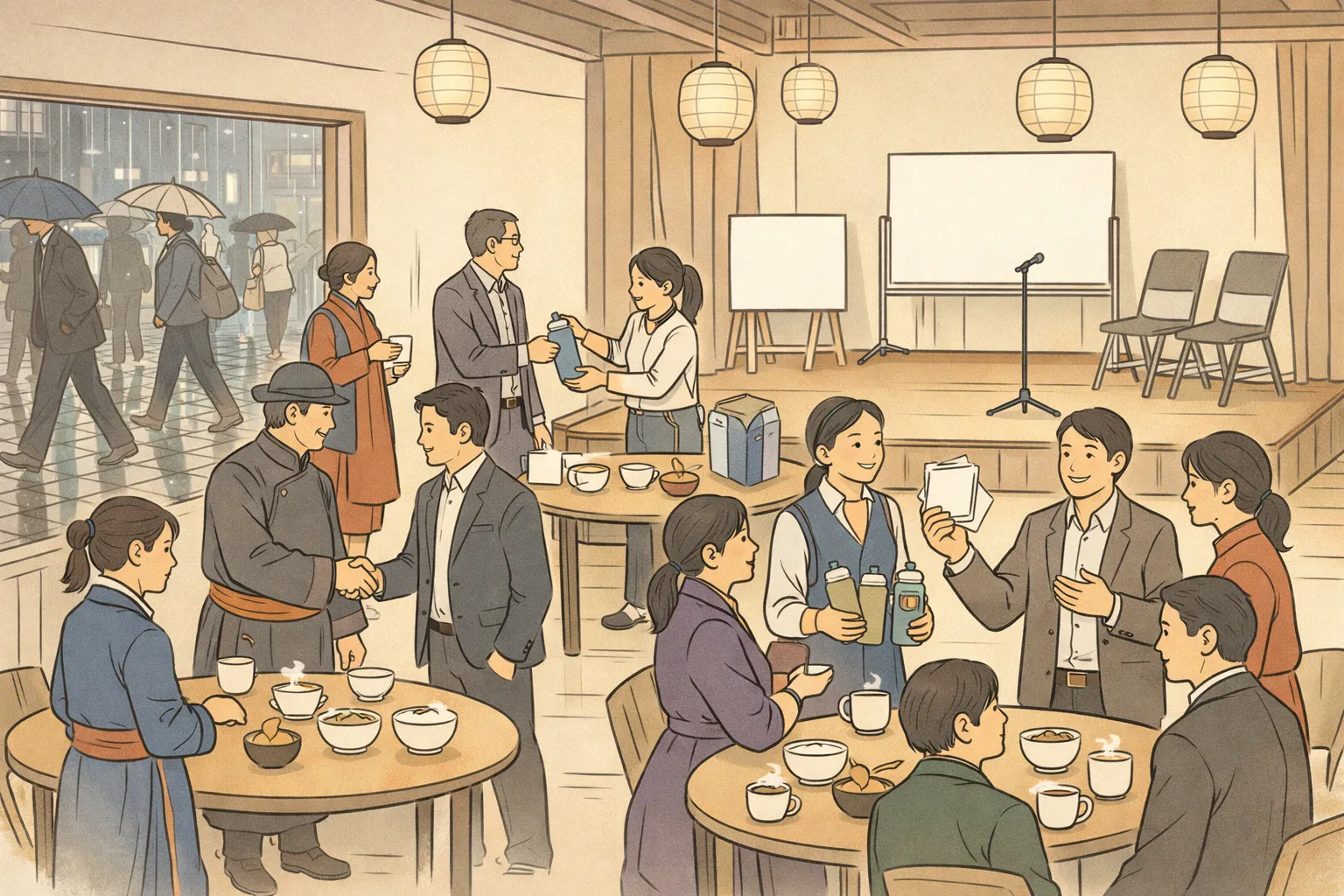
Job fairs for foreigners are beneficial events for Mongolians who want to work in Japan. At these fairs, Japanese companies provide job information targeting Mongolians, allowing direct interaction with companies.
LinkedIn/Meetup
LinkedIn and Meetup are online platforms that support job hunting activities in Japan. By utilizing these platforms, Mongolians can gain information and networking opportunities that are helpful for their job activities in Japan.
Mongolian Community
The Mongolian community is a group where Mongolians residing in Japan gather to exchange information and provide support. In these communities, advice regarding job activities in Japan and job information for Mongolians regarding full-time positions are shared.
Practical Steps from Pre-Participation Preparation to Day of Event and Thank You Communication
1. Pre-Participation Preparation
- Clarification of Purpose: Clearly define the purpose of participating in the event and consider how it will help with job hunting in Japan.
- Information Gathering: Research the event details, participating companies, and speaker profiles in advance, and prepare questions and topics for discussion.
- Preparation of Resume and Work History: Prepare a resume and work history that highlight your experiences and skills as a Mongolian.
2. On the Day
- Punctuality: Arrive at the venue before the event starts and act with plenty of time to spare.
- Active Participation: Actively participate in lectures and sessions, leaving an impression by asking questions and sharing opinions.
- Business Card Exchange: Exchange business cards with company representatives and other participants to share contact information.
3. Thank You Follow-Up
- Expressing Gratitude: After the event, send thank-you emails to the participating companies and speakers to strengthen your impression.
- Follow-Up: Engage in questions and information exchange regarding job hunting in Japan with the contacts you exchanged business cards with.
By practicing these steps, Mongolian individuals can advance their job hunting activities in Japan more effectively.
Points
Participation in industry study sessions and job fairs for foreigners is the key for Mongolians to succeed in their job hunting activities in Japan.
Preparation in advance, proactive actions on the day, and follow-up are essential.
Step
Content
Preparation Before Participation
Clarification of Objectives and Information Gathering
 03-6222-9855
 Guide to Working in Japan
 History
 About this site
 Login


 About this site
 Contact




































 COLUMN CATEGORY
 2026.08.03
Comment from the author
The workplace environment in Japan is unique, and Mongolians may often feel the cultural differences. It is important to understand the ambiguity of instructions, the significance of reading the atmosphere, and the hierarchical relationships. Please enjoy learning while adapting in the workplace and work with confidence.